The American West offers some of the most breathtaking and rugged landscapes on earth. From the sweeping deserts of Utah to the dense, unpredictable forests of the Pacific Northwest, overlanding allows you to explore areas that most people will never see.
But with deep exploration comes real danger. When you are fifty miles down a dirt road with no cell service, a simple mechanical failure or a sudden change in weather can quickly turn a fun weekend trip into a serious survival situation.
This is why your standard camping equipment isn’t enough. You need dedicated overlanding survival gear designed to keep you alive when things go wrong.
In this guide, we break down the seven non-negotiable bushcraft and survival items that every responsible truck camper must carry in 2026. This isn’t just about comfort; it’s about making sure you always make it back home.
Why Overlanding Requires Specialized Survival Gear
Many beginners confuse camping gear with survival gear. Your 12V fridge, comfortable sleeping platform, and portable power station are fantastic for camping. But if your truck breaks down and you have to abandon your rig to hike to safety, that heavy equipment becomes useless.
True survival gear must be lightweight, ultra-reliable, and focused on the “Rule of 3s”: You can survive 3 minutes without air, 3 hours without shelter in extreme environments, 3 days without water, and 3 weeks without food.
Your emergency kit must address these core human needs first. For the WildRigged adventurer, being prepared is the ultimate peace of mind.
1. Emergency Satellite Communication
When you leave the pavement, you usually leave your cell signal behind. In a life-threatening emergency—such as a snake bite, a severe injury, or a total vehicle failure in the desert—an SOS beacon is your only lifeline.
The Garmin inReach Mini 2 is currently the gold standard for overlanders. It is small enough to clip to your backpack, offers two-way text messaging via satellite, and features a dedicated SOS button that alerts local search and rescue teams directly to your GPS coordinates.
Never rely on your smartphone for emergency communication in the backcountry.
2. A High-Volume Water Purification System
You might carry ten gallons of fresh water in your truck bed, but what happens if your water tank leaks or you have to hike out on foot?
A reliable water purification system is critical. We highly recommend carrying a heavy-duty pump filter, like the MSR Guardian, alongside a personal system like the LifeStraw or Grayl GeoPress. These systems not only filter out dirt and bacteria but also eliminate viruses, which is crucial if you are forced to drink from stagnant water sources.
3. A Comprehensive Trauma First Aid Kit
A standard drugstore first aid kit with a few band-aids and some aspirin is not a survival kit. Overlanding involves axes, heavy machinery, winches, and rough terrain.
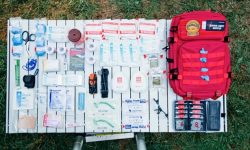
You need a trauma kit designed to stop severe bleeding and stabilize major injuries. Look for kits that include a CAT Tourniquet, Israeli bandages, QuikClot gauze, and a Sam Splint. Keep this kit easily accessible—ideally attached to the back of your headrest or the inside of your tailgate. In a trauma situation, you do not have time to dig through plastic bins.
4. Reliable Fire Starting Tools
Fire provides warmth, a way to boil water, a signal for rescue, and a psychological boost in a stressful situation. In survival scenarios, a cheap gas station lighter simply won’t cut it, especially in wet or freezing conditions.
Every truck camper should carry multiple ways to start a fire. A high-quality Ferrocerium rod (Ferro rod) can strike sparks even when soaking wet. Pair this with waterproof storm matches and a tinder source, like cotton balls soaked in petroleum jelly, stored in a waterproof container.
5. A Heavy-Duty Bushcraft Knife
Your kitchen knife is for chopping onions; a bushcraft knife is for survival. A fixed-blade, full-tang knife is arguably the most versatile tool you can carry into the wild.
You need a knife strong enough to “baton” through wood to process firewood, sharp enough to prepare food, and durable enough to handle heavy abuse. Brands like Morakniv (for budget-friendly options) or Benchmade and ESEE (for premium quality) are staples in the survival community. Always keep a sharpener in your kit to maintain the edge on the trail.
6. Emergency Vehicle Recovery Gear
While not traditionally considered “bushcraft,” getting your truck unstuck is often the first step in surviving an overlanding crisis. If you can save the truck, you save your shelter and your supplies.
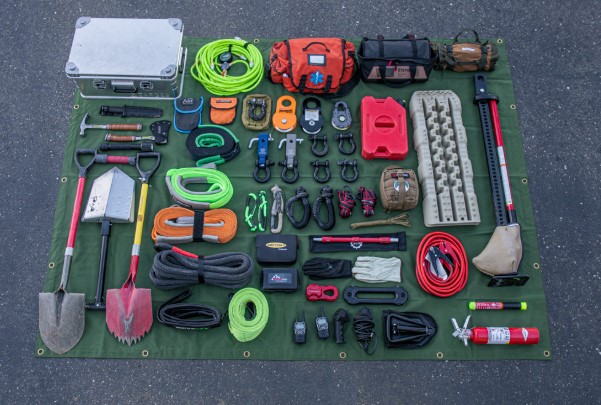
At a minimum, your rig should be equipped with recovery boards (like Maxtrax), a kinetic recovery rope, heavy-duty D-rings, and a reliable shovel. If you are traveling solo, a specialized off-road winch is a mandatory piece of survival gear.
7. A Dedicated “Bug Out Bag” (Go-Bag)
The most critical rule of overlanding survival is knowing when to abandon the vehicle. If a wildfire is approaching or your truck is hopelessly stuck in a blizzard, you may need to hike out to safety.
A Bug Out Bag (or Go-Bag) is a pre-packed, rugged backpack containing your satellite communicator, water filter, fire starters, emergency rations, a tarp for shelter, and your first aid kit. This bag should be fully packed and ready to grab at a moment’s notice. If you have to run, you shouldn’t be wasting time gathering loose items from your truck bed.
Final Thoughts: Respect the Wild
The wild is an incredible place, but it does not care about your itinerary. As an overlander, your truck is your primary survival tool, but your brain and your emergency gear are your ultimate safety net.
By equipping your rig with these seven essentials, you transition from being just a camper to becoming a capable, self-reliant adventurer. Build your kit, know how to use every item inside it, and hit the dirt roads with confidence.
Stay safe, stay prepared, and stay wild.